
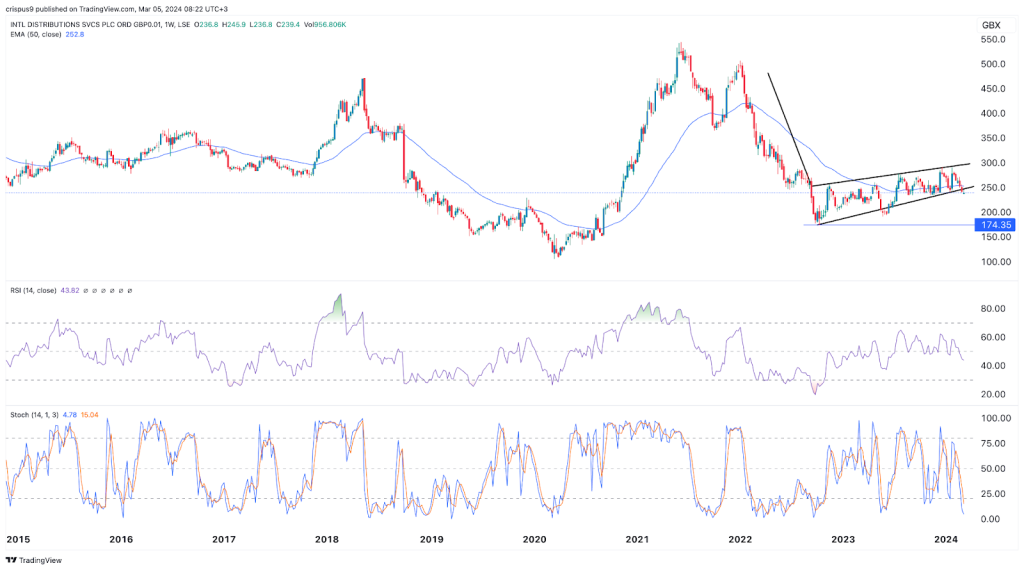
If you’ve typed “IDS share price” into a search bar lately and expected a live ticker, you probably hit a wall. That’s not a glitch, it’s the story. International Distribution Services plc (IDS), the owner of Royal Mail and GLS, no longer trades on the London Stock Exchange (LSE). Below is the complete, plain-English breakdown: what IDS was, why the price behaved the way it did through 2024–2025, where it ended up, and how to find the numbers you still might need.
What is IDS Share Price?
International Distribution Services (formerly Royal Mail Group plc) was the LSE-listed parent of two major delivery networks: Royal Mail in the UK and GLS across Europe and North America. In 2024–2025, IDS was at the center of a headline-grabbing takeover by Czech billionaire Daniel Křetínský’s EP Group. The government signed off late in 2024 with conditions to preserve Royal Mail’s UK identity (HQ, taxes, branding, and the universal service commitments), clearing the way for the deal to complete.
The turning point: a cash offer that anchored the price
For most of 2024 and into 2025, “IDS share price” stopped behaving like a normal, news-sensitive chart and started behaving like a ruler. Why? Because once a firm cash takeover offer is recommended and looks likely to complete, arbitrage closes the gap between the market price and the bid price.
That’s exactly what happened: EP Group’s offer valued IDS at ~£3.6–£5.3 billion depending on whether you include debt, and crucially it offered 370 pence in cash per share. From then on, the free-floating price gravitated toward ~370p, with modest day-to-day fluctuations reflecting deal risk, timing, and small-print conditions. Several market trackers, brokers, and newswires referenced that 370p cash consideration while the shares still traded.
So… what’s the “IDS share price” today?
There isn’t one—because IDS is not listed anymore. The offer went unconditional in spring 2025, acceptances surged past 90% (which enables compulsory acquisition under UK rules), and the company formally delisted on 2 June 2025. From that morning onward, you could no longer buy or sell IDS on the LSE’s Main Market. If you still held shares, you were swept into the cash takeover mechanics and ultimately received the offer consideration.
Why delisting matters for price look-ups
Once the listing is canceled, real-time quotes disappear from retail platforms and media tickers. Historic charts remain (on data sites that archive LSE closes), and corporate sites retain investor documents. But typing “IDS share price live” will yield stale snapshots or empty widgets because there is no exchange trading to feed them. If you need historic figures—say, the last close before delisting or the price path as the deal progressed—look to archival finance portals or IDS’s own investor relations material and RNS (Regulatory News Service) announcements around April–June 2025.
What pushed the deal across the line
A few big forces shaped the outcome:
-
Regulatory clearance: The UK approved the takeover with commitments (HQ in Britain, UK tax residency, service protections). One final wrinkle in Romania delayed the expected Q1 completion into Q2 2025, but those issues were ultimately resolved.
-
Operational turnaround pressure: Royal Mail had been wrestling with declining letter volumes, service-level scrutiny, and the heavy lift of modernisation. That context made a deep-pocketed owner—plus a clear investment thesis—appealing to the board and (eventually) to shareholders.
-
A firm cash price: The 370p offer set a clear anchor. As risk narrowed, arbitrageurs and index funds tightened the spread, compressing volatility into a narrow band until the shares were pulled from the market.
What happened next to the business, not the ticker
A few months after delisting, coverage focused on operations rather than share moves: delivery-standard reforms, automation, parcel-locker expansion, and the path back to profitability. That narrative is now the lead indicator for stakeholders because there’s no public share price to watch. Royal Mail has reported signs of financial improvement on adjusted measures, while still working through Ofcom-linked performance targets and the phased reshaping of second-class services.
How to find the numbers you still need
Even without a live quote, you can retrieve:
-
Offer terms (the 370p cash price, timetable, conditions): Check the Offer Document and related RNS notices from spring–early summer 2025. They spell out the unconditional date, compulsory acquisition steps, and delisting timetable.
-
Delisting date: RNS and LSE notices confirm cancellation of listing and trading took effect 08:00 on 2 June 2025.
-
Last trading prices: Market data archives (e.g., Stockopedia or similar services) show final prints around the mid-to-high 350s as the stock converged toward 370p in the days before cancellation.
Frequently asked questions
Can I still buy IDS shares?
No. The shares were delisted on 2 June 2025 following the EP Group takeover.
What did shareholders receive?
Cash—370p per share—under the recommended offer terms (subject to the standard settlement process and any shareholder-specific arrangements).
Where can I see old charts?
Use archival finance portals or LSE-linked RNS pages. Corporate investor relations libraries also keep presentations and annual reports for historical reference.
Why do some sites still show a quote box?
Some pages template in a ticker module that simply has nothing to display post-delisting. That doesn’t mean trading resumed; it means the instrument no longer has an active market.
Next: Total Sportek Arsenal: Your Smart Fan’s Guide to Fixtures, Coverage, and Safe Streaming
Conclusion
If your goal was to track “IDS share price” today, there isn’t a live market price to follow IDS is private. If your goal was to understand why the quote vanished and what price ultimately mattered, the answer is the cash offer at 370p and the 2 June 2025 delisting that turned a once-volatile public stock into a private-company story. Any current analysis now shifts from tick-by-tick moves to how the new owner executes on service, efficiency, and profitability in the years ahead without a public ticker to judge it by.
Note: All dates and figures above are correct as of November 3, 2025 and reference official RNS notices, reputable financial news outlets, and recognized market-data archives.