
When you look closely at the share-price journey of Prudential plc, it becomes clear that it’s more than just numbers flashing on a trading screen. It’s a story of strategic shifts, geographic exposure, and investor sentiment. Understanding what drives those numbers helps decode not only Prudential’s current valuation but also what its future may hold.
1. Where the Share Price Stands Today
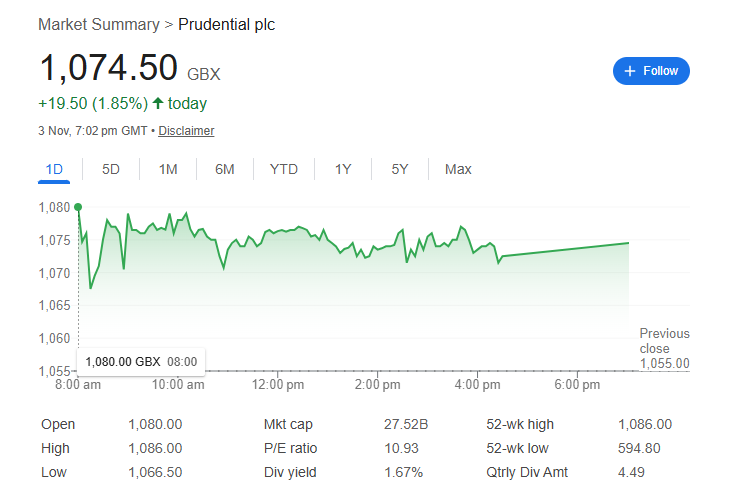
As of early November 2025, Prudential plc (ticker: PRU) is trading around £962 per share on the London Stock Exchange. Over the past year, the share has fluctuated within a broad 52-week range — from a low of about £595 to a high near £981. This kind of spread shows the volatility investors have faced, reflecting alternating waves of optimism and caution.
The company’s market capitalization sits near £26 billion, with a price-to-earnings (P/E) ratio of roughly 15 times. These metrics place Prudential comfortably in the mid-valuation zone of major financial stocks — not overpriced, but not a bargain either.
2. What’s Influencing the Share Price?
A. Regional and Business Exposure
Prudential’s business is distinct from many other London-listed insurers. Instead of being focused mainly on the UK or Europe, it has reoriented toward Asia and Africa, two regions brimming with long-term growth potential. This shift gives it access to emerging middle-class populations and rising insurance penetration — both powerful growth drivers.
However, that same exposure brings volatility. Political and currency risks in emerging markets, alongside regulatory changes and fluctuating consumer demand, can either boost or drag down results from quarter to quarter.
B. Capital Returns and Share Buybacks
Prudential has strengthened shareholder confidence through active capital-return programs. Recently, it announced a $1.1 billion share-buyback plan spread across 2026–2027, a clear signal of management’s confidence in its balance sheet and earnings trajectory. Buybacks reduce the number of shares in circulation, often lifting earnings per share (EPS) and supporting the stock price.
C. Macro Headwinds
While Prudential’s focus on Asia provides long-term opportunity, short-term macroeconomic conditions haven’t been easy. High global interest rates, inflationary pressures, and cautious investor sentiment have weighed on financial stocks. In particular, slow post-pandemic recovery in Hong Kong and regulatory uncertainties in China have created headwinds.
Company leadership has publicly described the recent share-price performance as “frustrating,” highlighting how broader market forces can sometimes overshadow strong operational results.
D. Valuation and Fundamentals
At a P/E ratio near 15 times, Prudential’s valuation suggests that the market expects steady, sustainable growth, not explosive expansion. The balance sheet remains solid, solvency ratios are comfortably above regulatory requirements, and cash generation is robust. The dividend yield continues to attract long-term investors, and management has set an ambitious target of 10% annual dividend growth through 2027 — an encouraging signal of confidence.
E. Catalysts and Investor Sentiment
In 2025, Prudential reported a 12% year-on-year rise in new-business profit, thanks to strong momentum in Asian markets. Investors also welcomed talk of potential public listings or restructuring of certain joint ventures, particularly in India, which could unlock hidden value. These developments have contributed to occasional surges in share price as investor confidence returns.
3. Interpreting the Price Movement
The Prudential share price hovering near the upper end of its 52-week range suggests a cautiously optimistic market mood. Investors seem to be pricing in stability with a tilt toward upside — though not without reservations.
-
Upside potential: If Asia and Africa continue showing strong economic expansion and Prudential executes well on its growth plans, there is room for the stock to push beyond the £1,000 mark.
-
Downside risk: However, if macro conditions worsen — say, a slowdown in China or another rise in interest rates — investors may retreat, driving the price lower again.
-
Valuation cushion: The current valuation acts as a buffer; it’s not overly inflated. This gives the share moderate resilience even if profits flatten temporarily.
Essentially, Prudential sits in a “wait-and-see” zone where execution and regional conditions will dictate the next major move.
4. Key Metrics and What to Watch
Investors tracking Prudential’s share price should keep a close eye on a few essential indicators:
-
52-Week Range: Low near £595 – High near £981.
-
Market Cap: Approximately £26–27 billion.
-
P/E Ratio: Roughly 15 × earnings.
-
New-Business Profit Growth: +12% in the latest half-year report.
-
Share-Buyback Program: $1.1 billion planned between 2026 and 2027.
-
Regional Growth: Hong Kong and Indonesia have posted double-digit growth in new sales.
-
Dividend Outlook: >10% annual dividend growth target through 2027.
These metrics together paint a picture of a financially strong but geographically sensitive company.
5. What Could Move the Share Price Next?
Positive Triggers
-
Faster economic rebound in Asia and Africa — driving higher insurance sales and investment income.
-
Successful completion of buybacks — creating steady demand for shares.
-
Value-unlocking events — such as IPOs or partnerships in high-growth markets like India or Vietnam.
-
Improved investor sentiment — as global markets stabilize and inflation moderates.
Negative Triggers
-
Economic turbulence in core regions, especially Hong Kong and mainland China.
-
Regulatory tightening or currency devaluations in emerging markets.
-
Unexpected losses or higher capital requirements that reduce dividend or buyback capacity.
-
Global market sell-offs affecting all financial stocks.
Valuation Scenarios
If Prudential delivers consistent double-digit earnings growth, the market may reward it with a higher multiple — perhaps a P/E of 18–20× — pushing the price toward new highs. But if growth stalls, the multiple could shrink toward 12×, implying a decline even without earnings drops. Thus, the share price will likely remain tightly correlated with earnings momentum.
6. Long-Term Outlook
Over the long run, Prudential’s strategy to focus on high-growth emerging markets could pay off handsomely. Rising disposable incomes, improving financial literacy, and expanding middle classes in countries like Malaysia, Indonesia, and Nigeria present strong demand for life and health insurance products.
The company’s investment arm, which manages billions in assets, also offers diversification benefits and recurring fee income. Combined with disciplined capital management and technological modernization, Prudential appears well positioned for sustainable growth.
However, investors must accept that this is a volatile journey. Share prices in emerging-market-exposed financial institutions rarely move in straight lines — they oscillate with global risk appetite.
Related:
Conclusion
The current Prudential share price hovering near £960 represents a snapshot of investor confidence balanced between optimism and caution. On one hand, the firm’s exposure to booming Asian and African markets, coupled with robust buybacks and dividends, signals enduring strength. On the other, macroeconomic uncertainty and global financial headwinds keep the stock from soaring too far.
For long-term investors, Prudential offers a blend of stability and growth, a defensive yet globally leveraged financial stock. Short-term traders may find volatility appealing, while income-seeking investors can appreciate its consistent dividends.
In the end, Prudential’s share price tells a broader story: one of global ambition, disciplined capital strategy, and a continuing tug-of-war between growth opportunity and economic gravity. How that story unfolds will determine whether future charts curve upward — or test the lows once again.