
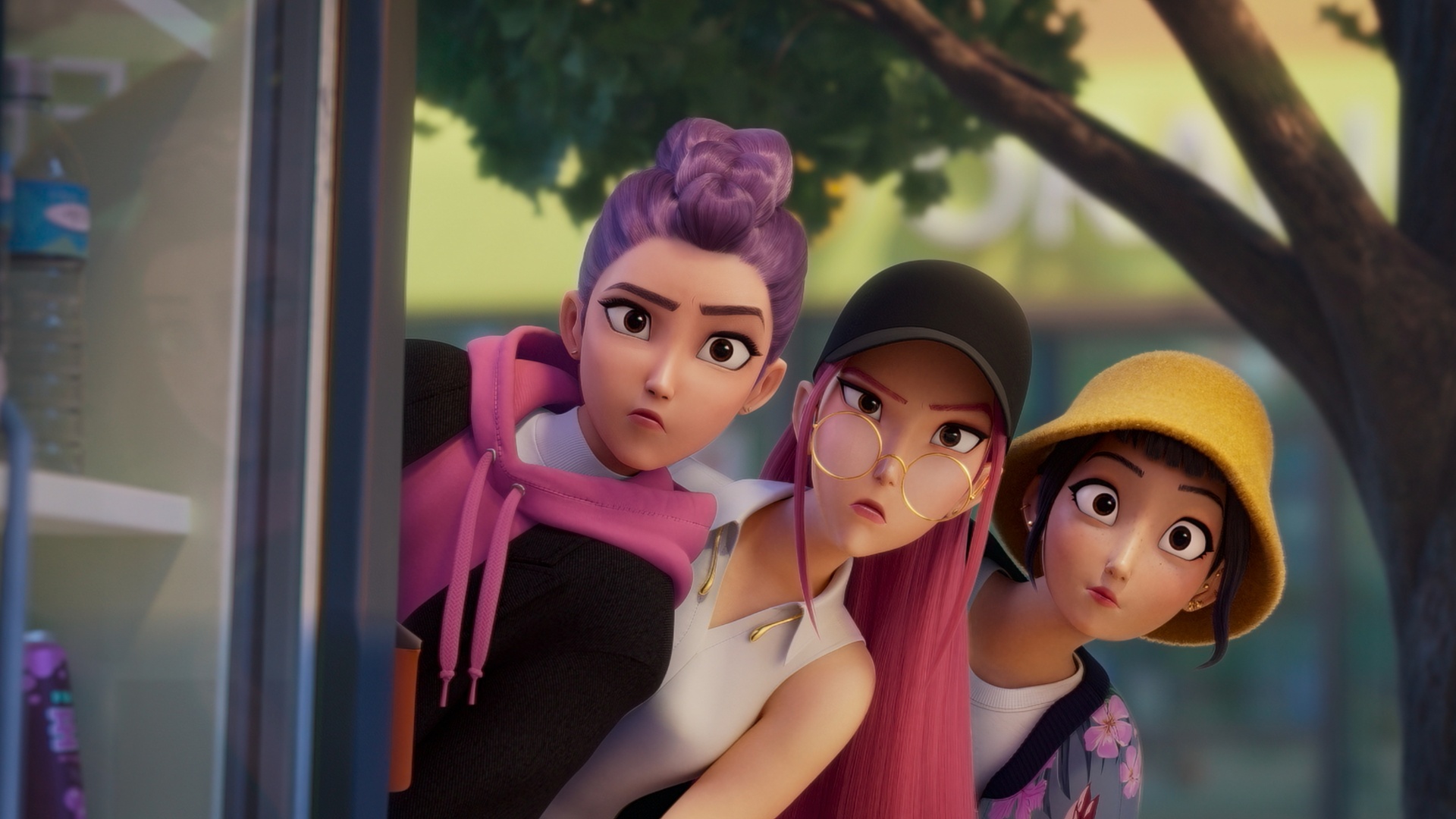
Meet Rumi: leader, main vocalist, and secret slayer
Rumi Kang is the fierce, purple-braided protagonist of K-Pop Demon Hunters, the animated musical phenomenon about a girl group that moonlights as a demon-hunting trio. Onstage, she leads HUNTR/X (pronounced “huntrix”) with razor-sharp vocals and unshakeable charisma; offstage, she shoulders the burden of a half-human, half-demon heritage while protecting the world from a rising supernatural threat. Within the story’s high-gloss pop veneer, Rumi functions as both the group’s moral compass and its tactical anchor, equal parts guardian, mentor, and main character.
Voice, singing voice, and the K-pop DNA behind her sound
Rumi’s speaking voice is performed by actor Arden Cho, while her singing voice belongs to the songwriter-vocalist EJAE—an intentional split casting that mirrors the K-pop industry’s meticulous approach to vocal production and performance. EJAE was initially brought on as a songwriter before her demos so perfectly fit the character that the team cast her as Rumi’s singing voice.
Cho, meanwhile, originally read for a different role before landing Rumi, further underlining how the character evolved alongside the creative team. The result is a heroine whose lines cut with conviction and whose melodies soar with idol polish, a hybrid that feels instantly believable to K-pop fans.
HUNTR/X, rival Saja Boys, and a pop-mythology that actually bangs
Rumi’s group, HUNTR/X modelled on real-world girl groups for look, choreography, and stagecraft—fights demons while managing the pressures of celebrity. Their foil is the Saja Boys, an ultra-slick rival boy band with a demonic edge. The film’s worldbuilding borrows the spectacle and archetypes of contemporary K-pop (think stadium lighting, MV-style edits, and fandom rituals) and fuses them with a hero’s-journey framework.
HUNTR/X’s breakout single “Golden” even escaped the screen to become a bona fide hit, topping global charts and—wildly—reaching No. 1 on the U.S. Billboard Hot 100, a first for any K-pop girl group, fictional or not. Rumi’s pop persona isn’t window dressing; it’s the fuel and the battlefield.
Themes: identity, chosen family, and coming clean
Rumi’s arc threads a needle between fan-friendly empowerment and unexpectedly tender metaphor. Co-director Maggie Kang has described Rumi’s journey as akin to “coming out”—not strictly in a sexual-identity sense, but in the broader act of revealing your true self when others want you to be something else. The push-pull between her idol duties and demon-hunting responsibilities isn’t just time management; it’s a narrative about self-acceptance, heritage, and the courage to set boundaries. The final musical numbers double as emotional resolutions, with lyrics and staging that transform stages into confessionals and battles into breakthroughs.
Visual swagger: 3D CG with music-video punch
Stylistically, K-Pop Demon Hunters leans into bold, graphic CG with a music-video sensibility: dramatic lighting cues, editorial framing, MV-style transitions, and a splash of anime-inspired facial styling. Sony Pictures Imageworks delivered a hybrid look 3D characters that can slide between “high-glamour” idol shots, angular “aggro” action beats, and super-cute “chibi” exaggerations when the tone flips. It’s a visual language that lets Rumi shape-shift emotionally, not just physically: leader on stage, sister off it, and storm-calm in combat.
Cultural breakout: from Netflix record-breaker to headline-making soundtrack
The film didn’t just trend; it detonated. K-Pop Demon Hunters became Netflix’s most-watched movie ever, with reports citing hundreds of millions of views globally, and even pulled off a rare feat for the streamer: a limited sing-along theatrical release that topped the U.S. weekend box office. The soundtrack moved in lockstep with the film’s momentum “Golden” crowned global charts, while multiple tracks packed the Hot 100’s top 10 in the same week, echoing the cross-media shockwaves of classic soundtrack booms. Rumi, as the face and voice of HUNTR/X, became the avatar for that surge fan cams, dance challenges, and stage-look recreations multiplied across social platforms, minting her as a pop-culture reference point almost overnight.
The character under the glitter: leadership and vulnerability
Beyond the braids and belts, Rumi is written as a working leader, decisive, protective, and sometimes stubborn. She’s the first to shoulder blame and the last to seek comfort. Her half-demon lineage isn’t an edgy accessory; it’s a narrative pressure cooker that intensifies every choice she makes. The film positions mentorship as muscle memory. Rumi watches over Mira and Zoey onstage and on the battlefield, calibrating harmonies and strategies alike. When fans talk about “favorite Rumi scenes,. They often cite the moments when her voice wavers—right before a high note, or right before a high-risk move—because the movie lets her be both unstoppable and unsure. (The lore-heavy fan sites deepen this picture with character notes, concept art, and backstory threads that highlight her responsibilities and inner conflicts.)
Why Rumi resonates with K-pop fandoms
K-pop thrives on team chemistry, visual identities, narrative breadcrumbs, and the sense that fans help “complete” an idol’s story. Rumi embodies that ecosystem. Her look telegraphs “center” without eclipsing her members. Her choreography reads like canon signature hand shapes, braid flicks and mic-arm silhouettes. The vocals carry the big, uplift chorus but leave space for sub-vocal textures (think harmonized belts and call-and-response hooks) so HUNTR/X feels like a real group, not just a lead with backup. For fans, she’s a case study in how an idol can be a character and a character can be an idol.
Fast facts to know (and flex)
-
Name & role: Rumi Kang, leader and main vocalist of HUNTR/X; main protagonist of K-Pop Demon Hunters.
-
Voices: Spoken by Arden Cho; sung by EJAE.
-
Rivals: Saja Boys, a demon-powered boy band (with lore and charting songs of their own).
-
Style & staging: High-gloss CG, anime-flavored faces, MV lighting, and chibi surges for comedic beats.
-
Impact: Netflix viewership record; sing-along theatrical weekend No. 1; “Golden” hit No. 1 in the U.S. and dominated global charts.
Where the story might go next
Given the scale of its breakout, chatter around sequels and character backstories Rumi’s included has already begun. Expect any follow-up to probe deeper into her heritage, her mentorship of the team, and the cost of being both idol and hunter. If the next instalment doubles down on the music-story feedback loop that powered the first—songs advancing character, choreography shaping plot Rumi will likely remain the emotional center of gravity, the place where fandom energy, soundtrack ambition, and supernatural stakes collide.
Related: Chess at Heavyweight: Joshua vs Usyk—Skill, Stakes, and the Science of Adjustments
Conclusion
Rumi works because she’s a complete idol and a complete character. She’s the mic-grabbing center who can sell a chorus, the field commander who can stare down a demon, and the young woman learning, in real time, what part of herself to show—and how loud to sing it. That’s why she isn’t just the face of K-Pop Demon Hunters; she’s its heart.