
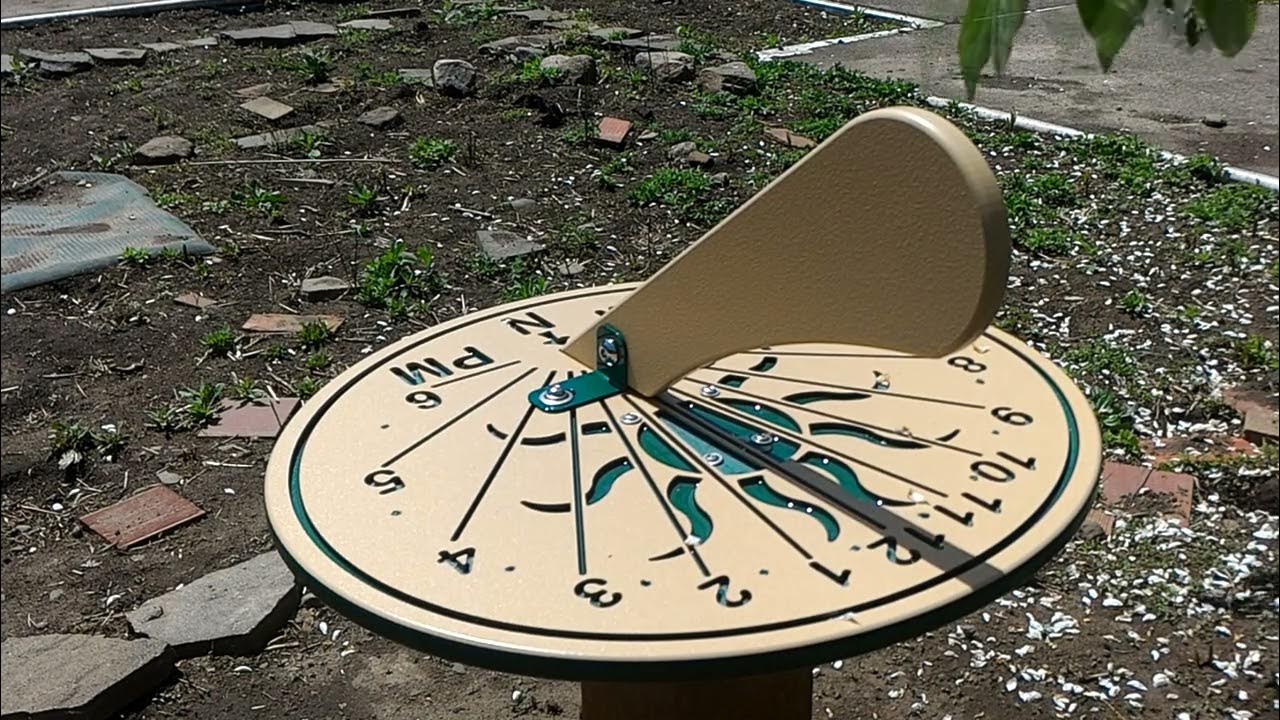
For thousands of years—long before digital clocks blinked in our pockets, before pendulums swung in elegant mechanical harmony—humanity relied on a deceptively simple yet astonishingly precise invention: the sun sundial. More than just a tool, the sundial is a fusion of astronomy, geometry, craftsmanship, and our instinctive desire to understand the passage of time. It is, in every sense, a collaboration between Earth and sky. But what makes the sun sundial so enduring, so captivating, and so scientifically profound? Let’s explore the remarkable story, mechanics, variations, and cultural impact of this ancient solar timekeeper.
A Brief Journey Into History: How the Sun Became a Clock
If we rewind civilization’s clock back to 3500 BCE, we discover that Egyptian and Babylonian astronomers were the first to notice something magical—the Sun’s shadow moves with predictable rhythm. That rhythm whispered the possibility of measuring time. Early sundials were little more than sticks placed upright in the ground, yet these “shadow clocks” evolved rapidly.
By 1500 BCE, Egyptians had carved sophisticated stone sundials, while the Greeks perfected the art with precise mathematical models. The Romans carried the concept across the empire, installing sundials in public squares as communal regulators of daily life. Asia, too, embraced solar timekeeping: China developed advanced horizontal and vertical sundials, while Islamic astronomers pushed the boundaries of accuracy through trigonometric refinements.
Thus, the sun sundial became the world’s first universal time standard—independent of culture, language, or geography. Wherever sunlight touched Earth, a sundial could speak.
The Science Behind the Shadow: How a Sundial Really Works
At its core, a sun sundial converts the Sun’s apparent motion into measurable time. But the elegant simplicity hides subtle, fascinating science.
1. The Gnomon — The Heart of the Sundial
The gnomon is the upright piece (often a rod or triangular blade) that casts the shadow. For the sundial to work accurately, the gnomon must point toward true north (in the Northern Hemisphere) or true south (in the Southern Hemisphere) and be aligned with Earth’s rotational axis.
Its angle must equal the latitude of the sundial’s location. This ensures the shadow behaves consistently year-round.
2. The Dial Plate — A Stage for Time
The dial plate holds the hour lines. Unlike the evenly spaced ticks on a modern clock, sundial hour lines radiate outward at unequal angles because the Earth rotates on a tilted axis.
3. The Sun’s Apparent Motion
As the Earth spins eastward, the Sun appears to travel westward across the sky. The gnomon’s shadow moves accordingly, sweeping across the dial in a predictable arc. At local solar noon, the shadow aligns with the meridian line.
4. The Equation of Time
One of the most intriguing parts of sundial science is that the Sun doesn’t keep perfectly uniform time. Due to Earth’s elliptical orbit and axial tilt, solar time can differ from clock time by as much as ±16 minutes. This is known as the Equation of Time, and many advanced sundials include correction curves or markings to account for it.
Types of Sun Sundials: A World of Designs and Purposes
Sundials are not a one-size-fits-all invention. Their variations reflect geography, science, and artistic expression.
• Horizontal Sundial
Perhaps the most iconic form, this sundial features a flat plate with hour markings and a slanted gnomon. It is commonly seen in gardens, observatories, and historical estates.
• Vertical Sundial
Mounted on walls facing the Sun, vertical sundials display time differently depending on the orientation—south-facing dials work all year, while east or west ones operate only half the day.
• Equatorial Sundial
The dial plate is aligned parallel to Earth’s equator. Its hour lines are spaced evenly, making it one of the easiest models to construct and read.
• Polar Sundial
Here, the shadow moves along lines parallel to the polar axis. A minimalistic yet mathematically elegant design.
• Analemmatic Sundial
A marvel of interactive design: instead of a fixed gnomon, the human body becomes the gnomon. Stand on the month marker, and your shadow tells the time.
• Armillary Sundial
A striking, spherical structure composed of rings representing celestial circles—equator, ecliptic, meridian. It serves both as a timepiece and a three-dimensional astronomical model.
• Portable Sundials
From Roman “pocket” sundials to exquisite medieval Islamic designs, humans have long sought ways to carry the Sun’s clock with them.
Each type demonstrates a different way of interpreting the Sun’s movement—a reminder that science and art often intertwine.
Why the Sun Sundial Still Matters Today
In an age of atomic clocks and satellites, why do sundials still appear in modern architecture, parks, observatories, and even research institutions?
1. A Living Demonstration of Astronomy
A sundial is not just an object—it is a working model of Earth’s rotation. Watching the shadow shift makes the sky feel closer and science more tangible.
2. Sustainability and Simplicity
Sundials require no electricity, no batteries, no upkeep. Their brilliance lies in using nature itself as a mechanism.
3. Educational Power
Schools and universities use sundials to teach:
-
celestial mechanics
-
geometry
-
Earth–Sun relationships
-
time measurement history
Students can literally see the cosmos in motion.
4. Cultural and Artistic Value
Sundials are sculptures with purpose. From medieval stone carvings to sleek stainless-steel monuments, they reflect the aesthetics of their era.
5. A Meditation on Time
In our fast-paced, hyper-digital world, a sundial’s slow-moving shadow is grounding. It reminds us that time is not just numbers—it’s a rhythm, a cycle, a dance of light.
How to Read a Sun Sundial (Even as a Beginner)
Reading a sundial may seem daunting, but anyone can do it:
-
Ensure the sundial is correctly aligned
The gnomon must point to true north, not magnetic north. -
Check the shadow
The tip of the shadow typically indicates the time. -
Understand it shows solar time
Not clock time—so note the Equation of Time adjustments. -
Account for time zones
Modern standard timezones can shift sundial readings by hours depending on your longitude. -
Observe seasonal differences
Shadow lengths change as the Sun’s path rises and falls throughout the year.
Mastering these elements transforms a simple shadow into a reliable time reading.
The Sun Sundial as a Symbol of Human Insight
Beyond its technical precision, the sun sundial is a symbol of something deeper—our collective human desire to interpret the heavens. It represents:
-
curiosity
-
innovation
-
patience
-
the merging of science and philosophy
Its inscription is written not in ink, but in sunlight. Its movement is gentle, continuous, ancient. Even today, a sundial stands as a reminder that understanding time begins with observing nature.
Related: Cadbury Garden Centre: A Complete Guide to Somerset’s Floral, Family & Lifestyle Haven
Conclusion
Though technology has evolved beyond imagination, the sun sundial remains timeless—literally and metaphorically. It is the earliest scientific instrument, the ancestor of clocks, and a testament to our relationship with the cosmos. Whether displayed in a garden, perched atop a university lawn, or reconstructed as an educational model, the sun sundial continues to inspire awe.
It is not just a tool to measure hours.
It is a poetic collaboration between sunlight and shadow—an ancient, elegant, and enduring bridge between Earth and Sky.