
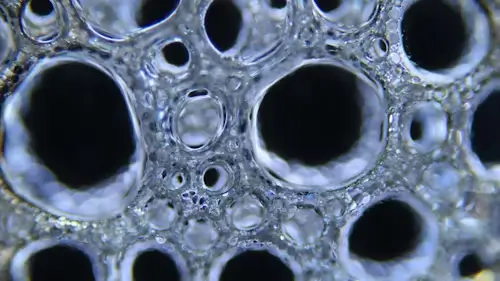
If you could shrink down small enough to explore the inside of your lungs, you’d discover a landscape that looks less like a biological organ and more like a sophisticated engineering marvel. The alveoli tiny air sacs at the end of the respiratory tree aren’t just simple structures. They are precision-designed biological machines, shaped, structured, and supplied in a way that maximizes one critical function: gas exchange. Oxygen in, carbon dioxide out. Alveoli are perfectly adapted for gas exchange with a large surface area, thin (one-cell thick) walls for short diffusion, a moist lining that lets gases dissolve easily, a dense capillary network to maintain steep concentration gradients, and constant airflow to refresh gases. Together, these adaptations allow humans to absorb enough oxygen to support brain function, movement, and every cellular process that keeps us alive.
These features don’t work independently, they interlock like gears in a machine. The shape increases surface area, the moisture dissolves gases, the thin membranes shorten diffusion distance, and blood flow keeps concentration gradients steep. On a microscopic level, everything about the alveoli screams efficiency.
What Are Alveoli?
Alveoli (singular: alveolus) are tiny balloon-like structures clustered at the ends of the bronchioles in the lungs. Adults have around 300–600 million of them, and their combined surface area can spread out to roughly the size of a tennis court. This enormous area is necessary because gas exchange needs to happen rapidly enough to meet the body’s oxygen demands each second.
Every breath you take fills these sacs with air. Every heartbeat pushes blood past them. This is where your external world meets your internal world where the oxygen you inhale enters your bloodstream and the carbon dioxide you exhale exits the body.
Key Adaptations of the Alveoli
To understand why alveoli are so efficient, we need to break down the adaptations that make them uniquely suited for gas exchange.
1. Massive Surface Area for Maximum Gas Exchange
Each alveolus is tiny, but millions of them combine to create a huge surface area. This allows a large volume of gases to diffuse across the membrane at the same time.
Why it matters:
-
Bigger surface = more space for oxygen to enter blood.
-
Faster diffusion = quicker delivery of oxygen to tissues.
-
Larger area prevents “traffic jams” of gas molecules.
It’s like comparing a narrow hallway to a stadium entrance—the more space, the smoother the flow.
2. Walls Only One Cell Thick for Short Diffusion Distance
The alveolar wall is made of a single layer of squamous epithelial cells. Right beside it, the capillary wall is also one cell thick. Together, these form the respiratory membrane, which is unbelievably thin—about 0.5 micrometers.
Why it matters:
-
Shorter distance = faster diffusion
-
Less resistance for gas exchange
-
Oxygen and carbon dioxide move almost instantly across membranes
This microscopic thinness is what allows breath-by-breath efficiency. If the walls were any thicker, every breath would feel like the world’s slowest traffic jam.
3. Moist Lining for Dissolving Gases
Every alveolus is coated in a thin film of moisture. Gases must dissolve before diffusing, and this film provides the perfect environment.
Why it matters:
-
Oxygen dissolves before crossing into the blood
-
CO₂ dissolves before exiting the capillaries
-
Prevents dryness and maintains membrane flexibility
Moisture acts like a biological slip-and-slide for gas molecules, allowing them to move effortlessly.
4. Dense Capillary Network for Constant Blood Flow
Surrounding each alveolus like a net is a web of capillaries. These bring deoxygenated blood in and carry oxygenated blood out, maintaining a steep concentration gradient.
Why it matters:
-
Fresh blood prevents equilibrium (which would stop diffusion)
-
Keeps oxygen concentration low in capillaries so more can enter
-
Moves carbon dioxide out rapidly to maintain balance
Think of this like a conveyor belt system that never stops supplying fresh “orders” for oxygen to fill.
5. Continuous Airflow to Refresh Oxygen Supply
Breathing ensures that stale air is pushed out and replaced with fresh, oxygen-rich air. This keeps oxygen levels high and carbon dioxide levels low inside the alveoli, maintaining the gradient that drives diffusion.
Why it matters:
-
Prevents stagnation of gases
-
Ensures steady oxygen availability
-
Helps eliminate carbon dioxide efficiently
No airflow = no gradient. No gradient = no gas exchange. Breathing keeps the system active and efficient.
How These Adaptations Work Together
It’s not just one feature that makes alveoli effective—it’s the combination:
| Adaptation | Role in Gas Exchange |
|---|---|
| Large surface area | More space for oxygen and CO₂ diffusion |
| Thin walls | Shorter diffusion distance, faster exchange |
| Moist lining | Allows gases to dissolve for membrane crossing |
| Rich blood supply | Maintains steep concentration gradients |
| Continuous airflow | Keeps oxygen levels high, CO₂ levels low |
This synergy is why the respiratory system doesn’t need conscious effort to function. Every piece works automatically.
What Happens When Alveolar Adaptations Are Damaged?
Certain conditions interfere with alveolar structure and efficiency, such as:
-
Emphysema: destroys alveolar walls, reducing surface area
-
Pulmonary edema: fluid buildup thickens membranes, slowing diffusion
-
Fibrosis: scar tissue increases diffusion distance
-
Infections (pneumonia): fluid and inflammation block airflow and gas movement
When adaptations are disrupted, the body struggles. Breathing becomes harder not because you can’t inhale air, but because the exchange of gases is inefficient.
Practical Significance of Alveolar Adaptations
These adaptations support life on every scale:
-
During exercise, oxygen demand skyrockets, and efficient alveoli meet the challenge.
-
At high altitudes, gradients weaken but alveoli still maximize every molecule.
-
In infants, alveoli continue developing, increasing capacity as the body grows.
No adaptation is accidental—each one exists because life depends on it.
Related: When May You Overtake Another Vehicle on the Left? A UK Road Rules Guide
Conclusion
Alveoli are engineered for efficiency. Their large surface area, thin walls, moist lining, dense capillary network, and continuous airflow form a system optimized for gas exchange. They work as a microscopic assembly line, transferring oxygen into the bloodstream and removing carbon dioxide with precision. Without these adaptations, breathing wouldn’t just be harder—it would be ineffective at sustaining life.
These tiny structures define what it means to live. Every heartbeat, every breath, every moment of energy begins here.
FAQ
What are alveoli adaptations?
Alveoli adaptations are structural features like thin walls, large surface area, moisture, and a dense capillary network that make gas exchange fast and efficient.
Why do alveoli have thin walls?
Their walls are only one cell thick to shorten the diffusion distance, allowing oxygen and carbon dioxide to move quickly between air and blood.
How does the large surface area help gas exchange?
Millions of alveoli increase the total surface area, allowing more gases to pass across the membrane at once, boosting oxygen intake.
Why is moisture important in the alveoli?
The moist lining dissolves gases so they can diffuse more easily across the membrane, improving gas exchange efficiency.
What role do capillaries play in alveoli function?
Capillaries maintain a steep concentration gradient by constantly bringing deoxygenated blood and carrying oxygenated blood away.