
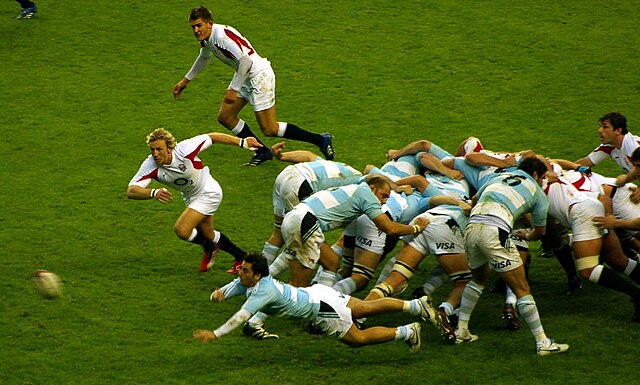
Rugby union gameplay is a wild mix of raw contact, precise strategy, and constant motion. Twenty-two players on the pitch, 15 per side, are locked in a battle to advance an oddly-shaped ball by running, passing, kicking, and tackling all while never passing forward by hand. To someone new, it can look chaotic. Underneath, though, there’s a very structured rhythm: set pieces, phases, territory, and moments of sudden brilliance that can change the game in a heartbeat.
The Objective: Territory, Possession, and Points
At its core, rugby union is about two things: keep the ball and gain ground. Teams fight to control possession through tackles, rucks, and set pieces, then use that possession to move into dangerous areas of the field.
You score points in several ways:
-
Try (5 points): Grounding the ball with downward pressure in the opponent’s in-goal area.
-
Conversion (2 points): After a try, a place kick or drop kick through the posts in line with where the try was scored.
-
Penalty Goal (3 points): Awarded after an opposition infringement; teams may kick for goal, touch, or a scrum.
-
Drop Goal (3 points): A player drops the ball and kicks it on the half-volley through the posts during open play.
Because of these options, gameplay constantly balances risk and reward. Sometimes a team keeps the ball in hand, playing multiple phases, looking for a defensive weakness. Other times, they deliberately kick long to flip territory, trusting their defense to force a mistake and regain possession further upfield.
The Structure of Play: Phases, Rucks, and Flow
Once the whistle blows and the ball is live, rugby union flows in phases:
-
Ball carrier runs into contact or space.
-
Tackle occurs: ball carrier taken to ground by one or more defenders.
-
Ruck forms: players from each team bind and push over the ball on the ground, trying to secure it with their feet.
-
Once the ball is available, the scrum-half passes to another runner or kicks.
This cycle can repeat over and over. A team might string together 10, 15, or even 20 phases if their ball retention and support play are strong.
Key concepts here:
-
Support lines: Teammates don’t just watch the runner; they track inside and outside, ready to receive a pass or secure the ruck.
-
Quick ball vs slow ball: If the scrum-half can pass the ball out immediately, the attack keeps the defense scrambling, often leading to overlaps. Slow ball gives defenders time to reorganize.
-
Offload game: Some teams use risky but devastating offloads in the tackle to keep the ball alive, never allowing a ruck to form and stressing defensive systems.
So what looks like chaos is actually a timed dance of spacing, timing, and decision-making, repeated phase after phase.
Set Pieces: Scrum, Lineout, and the Battle for the Platform
Rugby union gameplay leans heavily on set pieces, which serve as structured restarts and attacking platforms.
The Scrum
A scrum is formed after certain minor infringements (like a forward pass or knock-on). Eight forwards from each team bind together in three rows and push against each other. The scrum-half of the non-offending team feeds the ball down the middle, and the hooker tries to strike it back with the foot. A solid scrum:
-
Wins clean ball for the backs.
-
Can draw penalties if one pack dominates, allowing kicks for goal or touch.
-
Wears down the opposing forwards over time.
Dominate the scrum, and you control the pace and mindset of the match.
The Lineout
When the ball goes into touch (out of bounds), a lineout is formed. Forwards from each team line up perpendicular to the touchline, and the hooker throws the ball down the middle. Jumpers, often lifted by teammates, compete in the air.
Teams use lineouts to:
-
Call coded movements to confuse the defense.
-
Set up driving mauls, where the catcher stays on their feet and the pack binds and drives as a unit toward the try line.
-
Launch set moves for backs with pre-planned lines and decoy runners.
Set pieces are where a lot of coaching detail lives—timing, calls, lifting combinations, and deceptive throws all influence how dangerous a team is from restarts.
Positions and Roles: Forwards vs Backs
Every player on the field has a specific role, and rugby union gameplay makes sense when you see how those roles connect.
The Forwards (1–8)
The forwards are the engine room:
-
Props and Hooker (1, 2, 3): Front row of the scrum; provide stability, scrummaging power, and short carries.
-
Locks (4, 5): Tall jumpers, key in lineouts, provide pushing power in the scrum.
-
Flankers and Number 8 (6, 7, 8): Mobile ball hunters; make tackles, contest rucks, carry the ball, and support breaks.
Forwards focus on winning and recycling possession, dominating collisions, and giving the backs clean ball on the front foot.
The Backs (9–15)
The backs bring the speed, creativity, and finishing:
-
Scrum-half (9): Link between forwards and backs, controls tempo, chooses whether to pass, run, or kick from the base of rucks and scrums.
-
Fly-half (10): Chief playmaker; directs attack, calls moves, and often handles tactical kicking.
-
Centers (12, 13): Mix of power and agility, tasked with breaking the defensive line or distributing to wider players.
-
Wings (11, 14) & Fullback (15): Fast finishers, field kicks, counter-attack from deep, and exploit space out wide.
Rugby union gameplay is really the interaction between these units: forwards earning front-foot ball, backs exploiting space, and everyone defending together.
Kicking, Tactical Choices, and Game Management
Kicking isn’t just about scoring; it’s a huge part of tactical gameplay in rugby union.
Common kick types:
-
Box kick: From the scrum-half near a ruck to gain territory and contest in the air.
-
Grubber kick: Low, bouncing kick through the defensive line, tricky to collect.
-
High contestable kick (up-and-under): Gives chasers a chance to challenge the receiver.
-
Territorial clearance: Long kicks to push the opposition deep into their half.
Teams constantly decide between:
-
Running from deep and risking a turnover.
-
Kicking long and trusting defense.
-
Kicking to touch from a penalty to gain a lineout close to the try line.
-
Taking the points (penalty goal) versus chasing a try.
Good game management balances the score, the time left, field position, and the strengths of your own squad. A leading team might kick more for territory; a chasing team might run everything, accepting higher risk for higher reward.
Defense, Discipline, and the Breakdown Battle
Rugby union gameplay is brutal if your defense and discipline are weak. A team must:
-
Maintain line speed: Move up together to shut down space and time for the attack.
-
Tackle efficiently: Low, safe, and dominant, trying to push attackers backward.
-
Fold and reset: Defenders must quickly realign after each tackle to cover inside and outside channels.
Discipline is crucial. Infringements at the breakdown, high tackles, offsides, or off-the-ball interference can cost penalties, yellow cards (sin-bin), or even red cards. Playing one man down radically shifts momentum and tactics.
The breakdown—where the tackle, ruck, and contest for the ball happen—is often where games are won or lost. A turnover at the right moment can spark a counterattack and a match-winning try.
The Rhythm of a Match: Momentum and Intangibles
Beyond rules and structure, rugby union has a unique emotional rhythm. Momentum can swing on:
-
A huge scrum shove.
-
A crunching, legal tackle that lifts teammates.
-
A line break out of nowhere.
-
A captain choosing to go for the corner instead of taking a simple 3 points.
Players must manage fatigue, keep communication high, and adapt to the referee’s interpretation of the breakdown and offside line. The best teams read these “soft” aspects of gameplay and adjust their strategy on the fly.
Related: Future Ready Offices in Cyprus: How Workspaces Are Evolving for Tomorrow’s Teams
Conclusion
In the end, rugby union gameplay is a blend of collision and calculation. You have the heavy mechanics of scrums and mauls, the chess-like strategy of kicking and territory, and the spontaneous explosions of sidesteps, offloads, and last-second tackles. Once you understand how phases, positions, and set pieces interlock, the apparent chaos resolves into something far more satisfying a flowing, unpredictable contest where every decision, every meter gained, and every contact counts.