
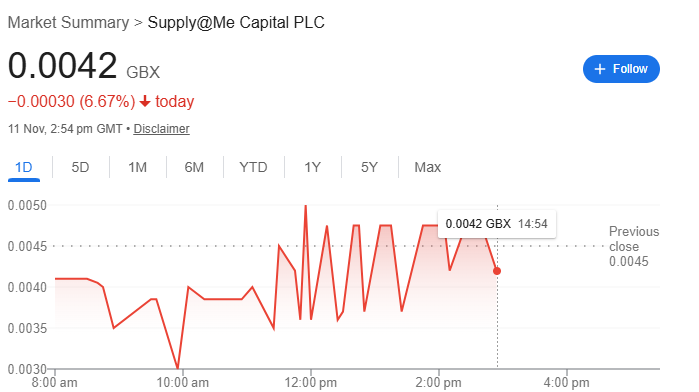
The share price of Supply@Me Capital plc (ticker: SYME, listed on the London Stock Exchange) offers a compelling, though highly speculative, snapshot into a micro-cap company operating at the fringes of the public markets. In this article, we’ll explore the current share price, the broader context of the business, the risks and potential upside, and what this means for investors.
Current Share Price Overview
As of the latest available data, SYME is trading at a minuscule level: around 0.0045 pence (GBX) on the London Stock Exchange.
Some sources cite 0.0028 GBX or even lower, reflecting periods of extremely low liquidity.
Its 52-week trading range is roughly from 0.0015 pence to ~0.016 pence.
Market capitalisation is similarly tiny: in the order of £3–4 million.
This is a penny-share in the literal sense, trading at fractions of a pence and dominated by speculative flows, not by mainstream institutional investment.
Business & Background: Understanding What SYME Actually Does
To make sense of the share price, one must understand the company behind it. Supply@Me Capital describes itself as a fintech/alternative finance business focusing on “inventory monetisation” for manufacturing and trading companies.
Essentially, the company claims to help firms unlock working capital tied up in inventory by offering financing or monetisation platforms. However:
-
Revenue is extremely low: e.g., one source reports annual turnover of GBP 129k.
-
Losses are significant: one site shows net profit of –£2.92 m for the year.
-
The high share count: ~71.73 billion shares outstanding.
For investors, these facts point to a high risk profile: minimal revenue base, large losses, tiny market cap, and hence likely very limited operational runway.
Why the Share Price Is So Low and What It Implies
Low Liquidity
One of the key structural reasons behind the ultra-low share price is very low trading volume and low investor interest. With only a few million pounds in market cap and hundreds of billions of shares outstanding, each trade can move the price substantially. For example: the bid-ask spread at one point was 0.004/0.005 pence.
Risk of Capital Erosion
Given the company is loss-making and has very little turnover, the value of the equity is essentially speculative. There is no guarantee of sustained profitable operations, which often leads to very low or even zero valuations by the market.
Penny-stock dynamics
Stocks trading at such tiny nominal prices tend to attract “micro-cap speculation” rather than long-term investment. Risk of dilution is high (company issuing more shares), regulatory risk is higher, and margin of error is small.
What the price does not reflect
-
It does not appear to reflect stable earnings, large cash reserves, or a dominant business model.
-
It should not be taken as safe or equivalent to mainstream listed companies with large market caps.
So the current low price is a combination of operational weakness + market structure (many shares, low liquidity) + high risk.
Potential Upside & Why Some Might Take a Chance
Despite the long list of risks, why would someone consider investing in SYME? Here are some theoretical “what-ifs”:
-
Turnaround potential: If Supply@Me were able to scale its business, secure a large contract, or significantly reduce losses, the share could re-rate from its current speculative value.
-
Low base, high possible multiple: At current valuation (e.g., ~£3 m market cap), even a modest commercial success could dramatically change the valuation multiple.
-
M&A or restructuring upside: Smaller companies sometimes become acquisition targets, restructure, or pivot to new business models — which could create upside beyond current expectations.
But each of these “potential upsides” is heavily caveated: they are speculative, uncertain, and carry high risk of failure.
Key Risks & Why Investors Should Be Cautious
Operational Risk
The business is loss-making and tiny in scale. Turnover of £129k in a year with a net loss of nearly £3m is not a strong base from which to grow.
Dilution Risk
With such low price and high share count, any new financing (equity or convertible debt) could dilute existing shareholders significantly. The fact that the company recently raised a convertible funding facility (~USD 5.15 m) has been noted.
Liquidity & Exit Risk
Because trading volume is low and share price tiny, entering and exiting positions may be difficult; spreads may be wide and small trades may move the price disproportionately.
Structural & Regulatory Risk
Smaller companies are more exposed to regulatory, market, or technology changes. Given the niche nature of the business (inventory monetisation fintech), execution risk is high.
Low Margin of Safety
With a share price so low, the margin of error is minimal — any negative news or missed milestone could wipe out investor value.
What to Watch: Indicators & Milestones
If you’re monitoring SYME (or considering it), here are key events/metrics to keep an eye on:
-
Quarterly/annual results: Turnover growth, margin improvement, narrowing losses.
-
Cash-flow and liquidity: Does the company have enough cash or access to capital without resorting to heavy dilution?
-
Major contracts or partnerships: Any credible deal that validates the business model could move the narrative.
-
Share-issuance announcements: Be alert to new equity or convertible debt which could dilute value.
-
Share-price range changes / market sentiment: In these micro-caps, sentiment can sway price more than fundamentals.
-
Regulatory or listing status: Any change in the company’s listing, compliance, or regulatory burden could have outsized effect.
Related: TUI Share Price: What Moves It, Where to Track It, and How to Read the Signals
Conclusion
The bottom line is this: Supply@Me Capital (SYME) is a high-risk, high-speculation play. The share price, hovering at fractions of a penny, reflects the precarious nature of the business, the tiny scale of operations, and the structural risks inherent in such micro-cap equities.
For a typical investor, the company would likely fall outside the “core” portfolio allocation. If you are considering it:
-
Treat it as very speculative (like a “lottery ticket” in investing).
-
Be aware you may lose all (or nearly all) of your invested capital.
-
Only allocate a very small portion of your investment budget if at all.
-
Have a clear stop-loss or exit strategy, and monitor closely.
Conversely, if Supply@Me can execute, scale its business, and secure strong contracts, the upside could be significant, simply because the current base valuation is so low. But that outcome is far from guaranteed.
In investing, especially in micro-caps, the rule of thumb is: “hope for the upside, prepare for the downside.” With SYME, the downside risk looms large given business fundamentals, and the upside is highly conditional.