
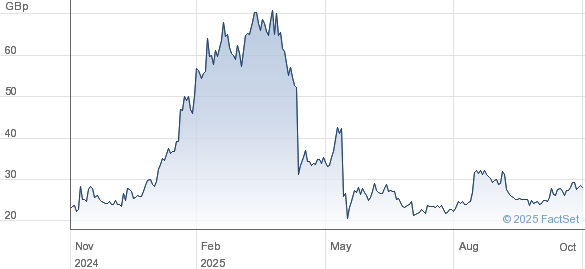
Quick Snapshot (as of November 3, 2025)
Pantheon Resources (ticker: PANR, London Stock Exchange) last traded around the high-20s pence, with many trackers quoting ~27–28p intraday. Over the past 12 months, PANR has swung between roughly 18.36p and 73.00p, a testament to how news-heavy and sentiment-sensitive this Alaska-focused explorer can be.
What Is PANR and Why Does Its Share Price Move So Much?
Pantheon Resources is a UK-listed oil and gas company pursuing onshore Alaska North Slope developments (notably the Ahpun/Alkaid area and newer prospects like Megrez and Dubhe). Because the company is still moving assets through appraisal, testing, and early commercial steps, each operational milestone a flow test, a fracture stimulation, an engineering report, a pipeline development can swing the valuation. The official site’s project timeline highlights recent and near-term milestones (IERs, recompletions, well tests) that investors watch closely because they feed directly into resource estimates, development design, and financing routes.
Today’s PANR Share Price Context: Range, Liquidity, and Momentum
Over the last year, PANR’s 52-week range spans the high-teens to the low-70s pence, a wide corridor that reflects alternating bursts of optimism (resource updates, infrastructure progress) and caution (execution risk, commodity price swings, dilution). Several market data sources show the recent print near ~27.5–28p, sitting roughly 50% above the 52-week low but well below the spring highs—an in-between zone that often telegraphs “prove-it” territory for the next catalyst.
If you’re benchmarking PANR’s current level, the London Stock Exchange and investor data hubs regularly publish rolling stats like shares in issue (~1.33bn) and market capitalization (mid-£300m range when the share price sits in the high-20s). These headline numbers help frame any per-barrel or per-resource-unit valuation you’re attempting.
Near-Term Catalysts: Wells, Tests, and Alaska Infrastructure
-
Dubhe-1 operations and testing. Company updates through late Q3 and Q4 2025 outlined fracture stimulation operations and plans for production testing. For an early-stage developer, meaningful, stable flow is the currency of the realm; test design, cleanup time, and fluid handling capacity all affect initial rates and how the market interprets them. Expect the share price to react not just to peak IP figures, but also to decline behaviour, drawdown, and fluid composition.
-
Gas commercialisation tailwinds. A 2024 Gas Sales Precedent Agreement with the Alaska Gasline Development Corporation (AGDC) created a commercial framework for future gas offtake, while a separate 2024/25 policy and consulting backdrop (including a Wood Mackenzie analysis to the Alaska Legislature) reinforced the notion that in-state pipeline solutions could carry significant net benefits. These developments don’t flip a switch overnight, but they bolster the idea that Pantheon’s hydrocarbons could tie into real infrastructure with clearer economics, a dynamic the market often capitalises into the share price as probabilities improve.
-
Macro/political signalling. Political support for Alaska’s pipeline build-out has, at times, supercharged sentiment in PANR. Public endorsements in late 2024 coincided with sharp price reactions, underscoring how macro headlines can rerate small/mid-cap E&Ps with large resource aspirations.
Key Risks That Can Pull the Price the Other Way
Operational execution: Stimulation success, mechanical reliability, and surface handling constraints can all throttle a test. A noisy, inconclusive flow or extended cleanup often dampens enthusiasm.
Resource quality vs. commerciality: Even if logs and petrophysics look promising, deliverability at surface must validate the development concept. Investors will scrutinise pressure behaviour, water cut, and long-term decline more than single-point IPs. Company Q&A and technical notes frequently caution that moving from discovery → development is a multi-stage proof process.
Funding pathway: Appraisal, facilities, and tie-ins require capital. Any equity raise or perceived need for one can pressure the share price in the short term even if it advances the long-term plan. Market pages occasionally flag past capital raises, which is typical for pre-cash-flow explorers but still a swing factor for price.
Commodity and policy volatility: Oil/gas prices and permitting/regulatory cadence in Alaska matter. Changes in timelines, costs, or policy stance can translate directly into valuation shifts—sometimes abruptly.
How Traders and Investors Read the PANR Chart
1) Respect the range. With a wide 52-week corridor (≈18–73p), technicians often mark support near the lower-20s and resistance in the 30s–40s on approach to catalyst windows, then reassess after test data lands. The amplitude reflects “event risk premium”: the market prices in both upside surprises and disappointment risk.
2) Volume tells the truth. When operational updates land, volume spikes either confirm a breakout or expose bull/bear traps. Watch trade recaps and on-book prints around RNS drops to gauge conviction.
3) Mind the fundamentals overlay. Chart levels alone won’t carry PANR; engineering steps (stims, cleanups, flow tests, facility constraints) are the catalysts that rewrite the technical picture. Marrying the chart to the operations calendar is essential.
What Could Rerate PANR from Here?
-
Clear, sustained production test results from Dubhe-1 or subsequent wells that demonstrate stable rates, manageable water cut, and repeatability across analogous locations.
-
Concrete progress on gas offtake and pipeline linkages (FEED/FID milestones, alignment with AGDC timelines) that tighten the path from molecules-in-the-ground to cash-flow.
-
Independent validation or resource upgrades (e.g., respected third-party assessments) that underpin reserve booking potential and field development planning.
Practical Takeaways If You’re Tracking the PANR Share Price
-
Use multiple data sources for live quotes and day ranges; different platforms may show small timing lags. Cross-check LSE, FT markets pages, and independent quote providers for confirmation.
-
Anchor expectations to the operations calendar. In the near term, eyes are on the fracture stim results and production testing cadence referenced in recent updates. Share price in the high-20s pence reflects a market waiting for “proof” rather than extrapolating best-case scenarios.
-
Remember the funding dimension. Progress often requires capital; news about raises or facility-backed financing can move the price independently of geology.
Related: Bristol Business Park: A Connected, Green Hub in North Bristol
Conclusion
The PANR share price sits in a volatile but potentially pivotal zone. The story is binary around execution: successful, repeatable test results and firmer infrastructure pathways could nudge investors toward development-ready valuations; weak or ambiguous outcomes may keep the stock tethered to the lower end of its range.
For now, PANR trades like a catalyst-driven appraisal name one where timely, high-quality operational data matters more than anything else. Track the next testing RNS, watch volumes on the tape, and keep an eye on Alaska’s policy/infrastructure drumbeat; together, those threads will likely dictate the next decisive move in the PANR share price.
This overview is informational and not investment advice. Always do your own research and consider professional guidance before making financial decisions.