
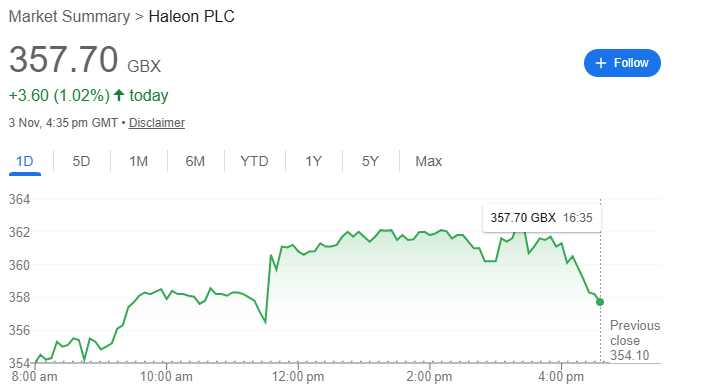
The share price of Haleon plc (HLN) has become a focal point for investors watching the global consumer healthcare sector. As one of the world’s largest companies in this space, home to brands like Sensodyne, Panadol, and Centrum, Haleon represents the steady, dependable side of equity markets. Yet its recent price performance has sparked curiosity: is this a hidden gem in a defensive sector, or a stock struggling to break through market expectations?
Below is a comprehensive look at Haleon’s share price, covering its current standing, historical behavior, market sentiment, valuation trends, and the key forces that could shape its next move.
1. The Current Position of Haleon’s Share Price
As of the most recent trading update, Haleon’s share price in the U.S. market sits around $9.38 per share, while its London-listed counterpart trades near 350–360 pence. These values reflect the company’s post-spin-off phase from GSK and Pfizer, where Haleon began operating as an independent public entity in mid-2022.
The stock’s modest valuation and stable trading pattern suggest that investors view Haleon as a reliable but not particularly high-growth company. Its price action also mirrors investor appetite for defensive, income-generating equities rather than speculative growth plays. The company’s focus on predictable earnings, strong brands, and stable demand for healthcare products underpins this steady performance.
2. Historical Performance and Market Behavior
In the past 52 weeks, Haleon’s share price has fluctuated within a range of $8.70 to $11.40, reflecting relatively low volatility compared to broader equity markets. The average price across the past year has hovered near $9.80, showing the market’s cautious but consistent valuation of the business.
In the London market, Haleon has underperformed the broader FTSE All-Share Index by a few percentage points, highlighting that while the company remains solid, it hasn’t captured strong momentum. This muted performance stems partly from the broader market environment—where inflation, higher interest rates, and cautious consumer spending have dampened enthusiasm for defensive consumer stocks.
Still, long-term investors often appreciate this steadiness. The limited downside volatility suggests the share has functioned as a relatively safe store of value within portfolios emphasizing health and wellness exposure.
3. Technical Indicators and Investor Sentiment
From a technical perspective, Haleon’s share price currently reflects a phase of consolidation rather than breakout growth. The 50-day and 200-day moving averages have flattened, showing limited directional bias. Technical analysts have rated the stock as neutral to mildly bearish, indicating that traders see more stability than upward momentum in the near term.
Resistance levels appear around 365–370 pence, while the lower support zone sits close to 325–330 pence. These boundaries have held firm, with the stock repeatedly bouncing between them throughout the year.
Interestingly, Haleon’s beta—a measure of volatility relative to the overall market—is around 0.2, which is significantly lower than most consumer goods peers. This means Haleon’s share price tends to move only modestly during market swings. For conservative investors or institutions seeking low-risk holdings, this stability makes Haleon an appealing option.
Investor sentiment overall leans cautious but positive. Analysts generally describe Haleon as “steady, resilient, and income-oriented,” favoring long-term holders over short-term traders.
4. Valuation, Earnings, and Growth Potential
Fundamentally, Haleon’s valuation aligns with its business model—predictable cash flow and modest growth. Its forward price-to-earnings ratio stands in the high teens, around 18 times forward earnings, suggesting fair value relative to expected growth.
Earnings forecasts indicate growth of roughly 13–14% over the next year, supported by cost optimization, strong brand performance, and expansion in emerging markets. Analysts’ consensus price targets hover around 420 pence, implying an upside potential of about 15–20% from current levels.
The company’s margins have remained resilient despite global inflation and rising logistics costs. Its strategy—streamlining operations, investing in brand strength, and implementing selective price increases—has protected profitability.
Haleon’s low debt levels, consistent cash generation, and healthy dividend payout ratio also contribute to its perception as a stable long-term investment. For many investors, it fits neatly into the “steady compounding” category of stocks: not spectacular, but solid and reliable.
5. Opportunities and Risks Influencing the Share Price
Opportunities
Haleon’s greatest strength lies in its brand portfolio of products that consumers around the world trust and buy repeatedly. This enduring brand loyalty drives strong recurring revenue, which provides insulation from economic downturns.
The company also stands to benefit from growing global interest in preventive health and wellness. With consumers increasingly seeking self-care solutions—like vitamins, supplements, and over-the-counter pain relief—Haleon is positioned in the right market segment.
Medium-term projections indicate that profits could grow in the high single digits annually, aided by new product launches, digital marketing expansion, and cost-reduction programs. Recent strategic decisions, including productivity initiatives and share buybacks, have further strengthened the investment case.
Risks
Despite these positives, Haleon faces notable challenges. The consumer health sector is maturing, which means growth is incremental rather than explosive. Rising competition from private-label brands and persistent cost inflation could squeeze margins.
Additionally, any macroeconomic slowdown or decline in consumer confidence may weigh on discretionary spending within non-essential healthcare categories. Regulatory risks also remain product recalls, compliance issues, or litigation related to legacy products could impact short-term valuations.
These risks, however, are typical of the consumer healthcare industry and are often balanced by Haleon’s scale and diversification across geographies and product lines.
6. What Could Drive Future Share Price Movement
Looking ahead, several factors could move Haleon’s share price meaningfully:
-
Earnings surprises: Strong quarterly results or upward earnings revisions could trigger a rerating from analysts.
-
Share buybacks and dividends: Continued shareholder-friendly actions may lift investor confidence and support price appreciation.
-
New product innovations: Breakthrough launches in oral health or supplements could expand market share and attract new investors.
-
Macroeconomic stability: If inflation eases and consumer sentiment improves, defensive stocks like Haleon may regain appeal.
-
Strategic acquisitions or partnerships: Expanding through targeted M&A could reignite growth momentum and improve valuation multiples.
Each of these drivers represents potential catalysts for breaking out of the current price range, pushing Haleon closer to its optimistic analyst targets.
Related:
- PANR Share Price Today: What’s Driving Pantheon Resources Right Now?
- Vistry Share Price: What’s Driving VTY and Where It Could Go Next
- IDS Share Price: What Happened to Royal Mail’s Parent on the London Market?
Conclusion
In summary, Haleon’s share price embodies a story of stability and resilience in a turbulent market. At around $9.38 per ADR and 350–360 pence in London, the stock trades at a fair value that reflects dependable earnings rather than explosive growth.
Its historical steadiness, low volatility, and consistent dividend make it particularly appealing to long-term, risk-averse investors seeking exposure to the global consumer health industry. The moderate upside potential driven by brand strength, buybacks, and solid earnings growth suggests a stock that rewards patience rather than speculation.
Haleon may not deliver overnight windfalls, but it offers something increasingly rare in the modern market: predictability, credibility, and quiet financial strength. For investors looking beyond short-term noise, this could be a share worth holding into the coming decade.